Mapping Ancient Skies
(2024-2027)
PI of project funded by Austrian Academy of Science.
Guest Scientist at Freie Universität Berlin, Institute for the History of Knowledge.
In the German academic system “Habilitationsäquivalent”.
supervising students:
- Youla Azkarrula (.id)
- Sadegh Faghanpour (Iran)
- Moritz Rätz (.de)
- Jakob Eyermann (.de)
Planetarium Babylonicum 2.0
(2024-2025)
PI of the project with Prof. H. Hunger, Vienna.
Guest scientist at the University of Science and Technology of China.
Guest scientist at Brown University, USA, Dept. Assyriology and Egyptology.
Guest scientist at Friedrich-Schiller-Universität Jena, Germany (Digital Humanities, Computer Science, German Studies, Assyriology and History of Science).
European tandem project with Horowitz’s “Babylonian Star Heaven” at HUJ.
All Skies Encyclopaedia (PI)
-forever-
The International Astronomical Union (IAU) needs a repository to store information (historical sources as images and text, and historians’ interpretations) on historical and indigenous names of stars and constellations. All humanities studies have the same/ similar technical requirements and map their names to the modern IAU constellation names. Hence, I aimed for a shared repo project with global distribution of backup servers for secure data management.
Modern Star Names
(IAU WGSN)
I am working on a data management concept for names, cultural backgrounds and etymologies.
solution:
All Skies Encyclopaedia
Babylonian Star Heaven
PI task group Identifications
(2021-2024)
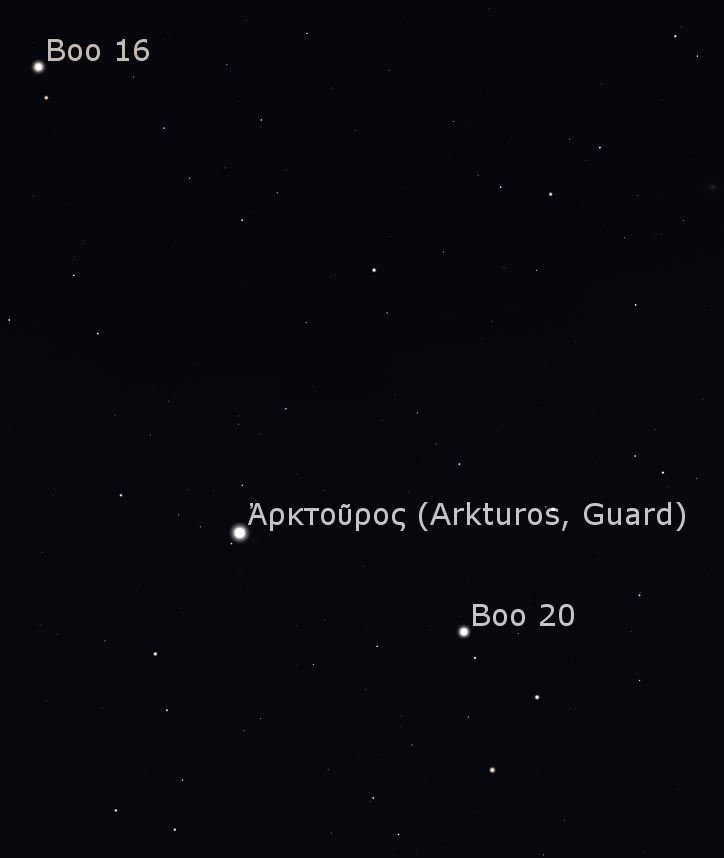
The project, funded by the Israel Science Foundation, is designed to produce a dictionary of Babylonian star names (collaboration of G. Kurtik and W. Horowitz). My co-project contributes revised identifications of star names, star clusters, constellations, and all types of asterisms.
Constellations of the World
(Stellarium Team Member,
since 2019/’20)
The open-source planetarium software Stellarium features a growing number of “sky cultures”, i.e. sets of constellations as a result of cultural and historical research. As a data curator, I tidy up the metadata and care for its better organisation.
The descriptions as of January 2022 are included in this volume, “Astronomy in Culture – Cultures of Astronomy”.

Applied and Computational Historical Astronomy
(2020-2021)
(solo organiser)
The term “applied hist. astr.” refers to research in astronomy and astrophysics that combines modern and historical data.
The contributions cover several sorts of studies in archaeology and the history of astronomy with computer simulations, as well as the use of historical data for modern research in astronomy and its history.
Star Names and Star Lists
(since 2022-2024)
Planetarium Babylonicum (PI)
Planetarium Sinicum (PI -> Co-PI)
Naked Eye star Catalogue (PI)
Together with colleague scholars distributed all over the world, I am developing a huge global encyclopaedia.
Astronomy in Culture – Cultures of Astronomy
(2021-2022)
(organiser and editor)
The splinter meeting on this topic was organised in collaboration with Prof. em. Dr. Gudrun Wolfschmidt. The contributions to the volume in her series “Nuncius Hamburgensis” cover tangible and intangible astronomical heritage (e.g. observatories and constellations).

Book 2021

Book 2022
Transients
(2017-2025)
( )
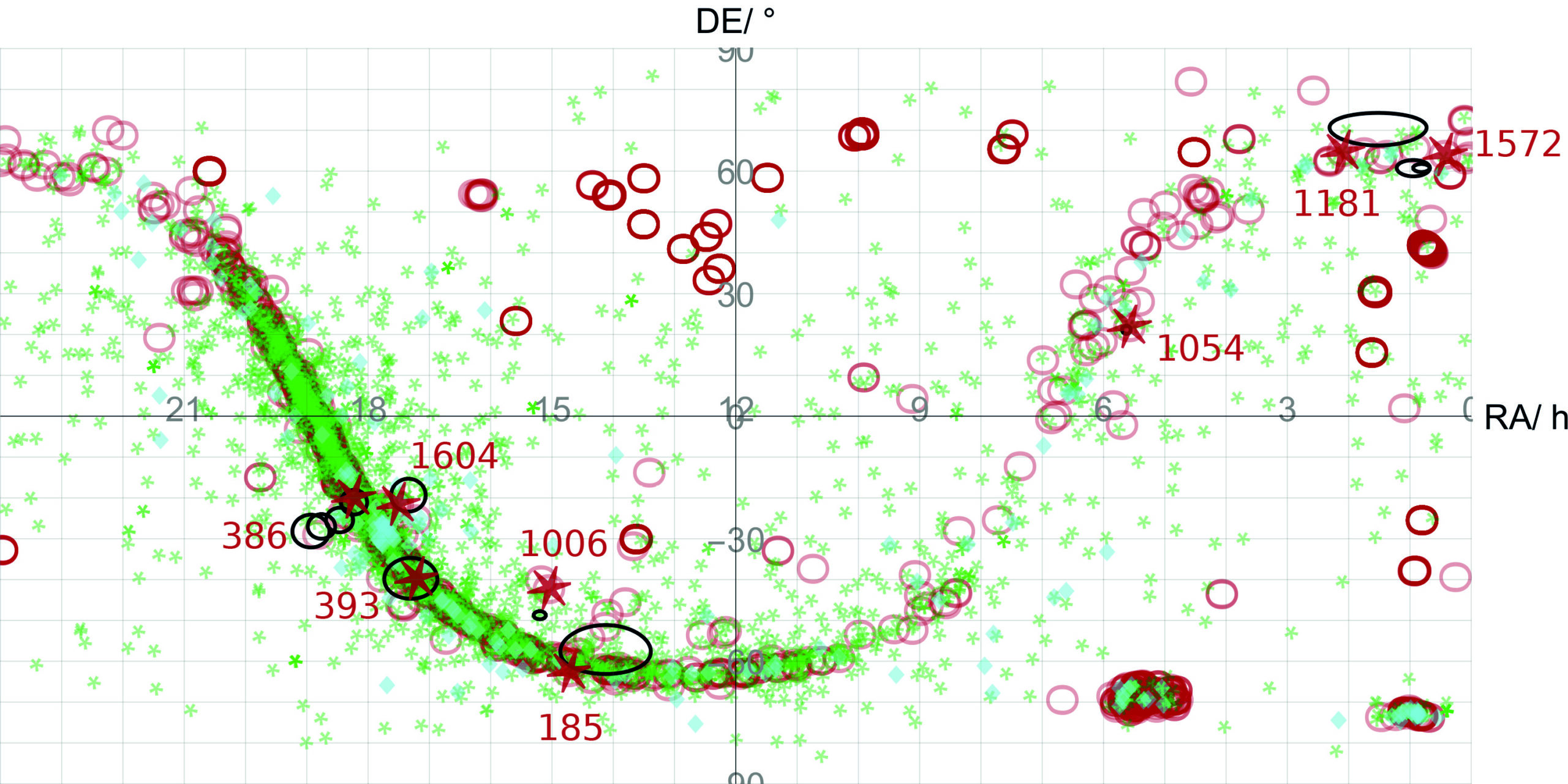
Ancient observers occasionally recognised variabilities in the (apparently static) night sky. In particular, East Asian astronomers recorded these observations because they were relevant to East Asian astral divination practices. Modern astronomy in the 19th and 20th centuries started to understand variabilities and eruptions of stars. Therefore, we can try to identify what ancient observers might have seen. In favourable cases, these identifications could possibly even contribute to modern astrophysics.
Reconstruction of
Ptolemy’s armillary sphere
(2018-2019)
(supervised student)
As a master’s thesis supervised by me, we constructed an armillary sphere based on the description in the Almagest and conducted test observations.
The result is that observations are possible, but the instrument must be calibrated every few minutes during the night, and a planet is needed for this procedure. This makes the observation of the star catalogue a long-term project.
Magnitudes in pre-telescopic star catalogues
(2019)
(supervised student)
The brightness of stars is measured in the strange unit “magnitude” (size), which goes back to antiquity. It is first preserved in the Almagest but at that time not new. It is unknown who invented this unit and why, namely, how it was measured, but the usual suspect is Hipparchus.
I supervised a master’s thesis in astrophysics on the topic of studying the error bars of magnitudes in the three pre-telescopic star catalogues. With a feasibility study, we proved that an observation of these magnitudes with grey wedges (and similarly in a twilight atmosphere) is possible. Additionally, I suggested that the magnitude was not measured in the sky but estimated using templates for star sizes on a globe.


Stars Above Horizon – Citizen Science (App Development)
(2018-2022)
(supervised students)
For the visibility of stars in twilight, I wanted to have a smartphone app in order to collect data from many people (different eyes) and from all over the world.
One student of physics, in a project thesis, developed a prototype for a feasibility study (2018-2020).
Four students in a software development project in computer science developed the first released version in 2021.
One computer science student developed an upgrade released in 2022.
Meteorology Beyond Borders
(2022-2023)
(Co-PI / Collaborator)
For Aristotle, “meteorology” was a term that designated everything in the heavens and air that is observed to be unstable.
This concerns weather phenomena in the sky and in underground caves, as well as transient astronomical objects like comets, novae, and supernovae.
In close collaboration with the classicist Dr. Giouli Korobili, this website was developed for the presentation of the scientific results of our projects on “Geoanatomy” and “Transients”.
Ptolemy’s constellations in Stellarium
(2019-2020)
(supervised students)
Four high school students (supervised by me) developed the stick figures of constellations as described in the Almagest.
This was a one-year project and first exercise in working with data and ancient Greek text for them.
They were awarded a special prize from the Thuringian State Ministry of Culture in January 2021.


ZODIAC goes planetarium
(Babylonian and Egyptian Sky)
2022
(Collaborator)
For the opening of the ZODIAC conference in Berlin at the Berlin Planetarium, I prepared a full-dome talk presenting the visualisations of some Babylonian constellations and the Dendarah zodiac as a non-purely Egyptian one.
Travelling in Egypt in the framework of a DAAD exchange project, I met friendly Egyptologists who gave me a tour in Esna and Dendarah. Compared to my work on the reconstruction of Babylonian constellations, this led to some suggestions for a new version of the circular Dendarah zodiac.

Planetarium Dantis:
Astronomie in Dante Alighieri
2022
(Collaborator)

Planetarium Usage in University Education
2022
(PI)
In Germany, planetariums are visited on excursions by elementary school classes but not used in higher education.
As modern “Digital Dome Theatres”, they have developed far from their original purpose of displaying and educating about astronomy.
In 2022, as part of the project “Planetarische Universität”, I tested various ways to use planetariums for university purposes. In addition to hosting conferences with dome talks, I also used the dome for special visualisations in class (e.g., the motion of the Moon). With my students in history of science (and earlier, with teacher training classes), I visited the planetariums in Jena, Nuremberg, and Ursensollen.

Dr. Monika Staesche, Prof. Dr. Dr. Mathieu Ossendrijver, & me

PD Dr. K.-Ph. Ellerbrock, B. Zöll, Prof. Dr. E. Costadura, me, Prof. em. Dr. D. Blume

Prof. Mändl, Dr. Ch. Reiss and me (with students)
Hipparchs Himmelsglobus
(Hipparchus’s Celestial Globe)
(2013-2015)
(PI)
Hipparchus is publicly known as one of the greatest astronomers in antiquity: a brilliant observer who a) discovered a “new star”, b) proved the existence of the precession of the equinoxes, c) made the first star catalogue and d) described a new method to make celestial globes.
He lived in a time (2nd century BCE) when Babylonian mathematics was taken over by Greek astronomers, which caused suspicion that he might have used Babylonian data for his groundbreaking innovations. My new analysis supports this idea, but the missing link has not yet been found.
History of the 88 Modern Constellations
(2020-2021)
(PI)
The constellations used in modern astronomy are an accurate division of the sky. They are based on historical constellations that had never been canonical before the 1920s. Some were invented by astronomers in the early modern era, but none were invented by “old men at campfires” just for fun, as planetariums often suggest. The systematic transfer and transformation of the constellation images from mnemograms (for seasons) to deities and into the modern images is outlined in this book.
Rathenower Riesenfernrohr
(Rathenow’s Giant Telescope)
2008
(PI)
The city of Rathenow is located in the middle between Berlin and Hanover. This town hosts the world’s biggest Schupmann telescope of the type “Brachymedial Typ B” (Schupmann 1899). In 2008, the telescope was dismantled and rebuilt at another place within the town. I documented this project for the public and studied the oral history of the telescope and its maker.

Book 2017

(profiles of 2-4 pages per constellation)
Book 2021

Book: 2015
Farnese Globe in Dome
(2017)
(PI)
The marble globe of the Atlas Farnese, a statue from antiquity rediscovered in the 16th century in one of the villas of the Farnese family close to Rome, carries a relatively accurate celestial atlas.
My attempt to make them available for planetarium use led to some new results for the interpretation of the globe.
The images are also available as “sky culture” in Stellarium.
Leiden Aratea in Dome
(2020)
(PI)
The Carolingian manuscript of the Aratea is preserved in two versions: one from Leiden and one from Metz. In collaboration with the Jena art historian Prof. Dr. Dieter Blume, I arranged the medieval paintings in the dome in order to make them usable for planetarium shows and talks.
The images are also available as “sky culture” in Stellarium.
The MUL.APIN-Planetarium
(2016-2017)
(PI)
MUL.APIN is the earliest known compendium of astronomy. It is written in the Akkadian language on clay tablets, dating probably to around 1000 BCE (with earlier dates for its components). It contains a “catalogue of asterisms” with which we can reconstruct the Babylonian constellations.
However, these constellations have never been canonical – so some identifications are rather uncertain or ambiguous (change of time).
Conference Opening 2017
(two Babylonian sky cultures available in Stellarium since 2018)


Show: 2016 (Münster),
Conference Talk 2017 (Jena),
further use: Berlin 1+2, Jena
Long ago
modelling Wolf-Rayet stars
student assistent in a group of theoretical astrophysics
modelling microlensing light curves
thesis in theoretical astrophysics:
observability of moons of exoplanets at large distances
teaching relativity
supervised and co-supervised numerous BA- and MA-theses for the development of teaching units on special and general relativity
Tourismuspreis (2006)
Karawane der Astronomie
walking tours in the desert, one week, no water for washing etc., only sand dunes, a mattress and dromedaries for the luggage…
lessons of astronomy in the evening and meditation during the day
Theatre Play in Planetarium
(2003)
to use the sky display in the scenery of a theatre play is a great combination of scientific correctness in edutainment
The Earth’s circumference at school excursion (1997)
During a school excursion to Greece, we made measurements of the length of the shadow of some pencils to determine the height of the Sun. Comparing this value to the one from a friend who measured the same day in Berlin, we determined the circumference of the Earth with this ancient method.
Invented Astronomisches Sommerlager (ASL)
Inspired by the massive success of an international astronomical youth camp held for the total solar eclipse of 1999, I, together with other astronomy students, founded a regular German-speaking youth camp in 2000 and developed it into an annual event from 2000 to 2006.
In 2007, I organised the first Berlin Space Camps; in 2008, an excursion to observe the total solar eclipse in Siberia.
Established VEGA e.V.
To create a better framework and more free environment for young astronomers, I established the body corporate VEreinigung für juGendarbeit in der Astronomie VEGA e.V. The association was entered in the register of associations at the Berlin District Court in 2004.
Stiftung (Foundation)
When I stopped being “young” myself (e.g., grew older than 29 Earth years), I aimed to create a legal body to support my successors among young astronomers in organising youth camps like the ASL and other VEGA activities.
For long time, I haven’t participated in any of the youth work activities, but I am tremendously happy, that the organisations still exist and support young people to discover the universe.